
 wiki.secretGeek
What Links Here?
Outbound Links
- All models are wrong, some models are useful
- https://www.ag.gov.au/rights-and-protections/human-rights-and-anti-discrimination/human-rights-scrutiny/public-sector-guidance-sheets/presumption-innocence
- 🖼️ "On the other hand, physicists like to say physics is to math as sex is to masturbation."
- https://archive.md/DaBme
- https://en.m.wikipedia.org/wiki/Lie#White_lie
- xkcd: Purity
- Three types of mathematical models | Theory, Evolution, and Games Group
- ⭐ what-is-the-half-life-of-a-mystery
- ⭐ dependency-graph-for-knowledge
- all models are wrong — secretGeek
Types of Truth and Proof
Sitting here now, in the charred ruins of our so called civilisation, it occurs to me that a few words may be in order.
I speak these words — whisper them — into the infinite chasm, the endless void, the darkening abyss - I croak these words and expect them only to be heard by — and lost upon — the dirge-filled crickets, the scampering cockroaches, the resilient bacterium and curious virii; these are now the only life forms remaining.
Truth sounds like a "universal" concept, like there is only one definition of truth, and if we can all agree on the facts then we will all come to the same conclusions. Some truths may be relative, not absolute, but all truths are compatible with all other truths. There is one emerging consistent set of facts in this universe. You can count on it.
In this essay mdash; written here in the smoking ash of a destroyed and once mighty civilization — I will argue that there are several different types of “truth”, that they were generally incompatible with each other, and I'll attempt to show how the confusion between these different types of truth lead with deadly inevitably toward our complete and utter destruction.
You may think of course there is "absolute" truth and "relative" truth and think you’ve got it covered. No — that’s not where we’re going; it’s not even where we’re starting.
Types of truth and proof I intend to cover:
- Mathematics
- Science
- Legal
- Political
- Engineering
- Sporting
- Truth in Poker
- Truth in War
- Artistic Truth
- “Social” truth
Mathematical Truth
A recent invention is “mathematical truth”. This is powerful stuff. If 2 + 2 = 4 and we know how the plus and minus operators work then it is “true” that 4 - 2 = 2. It’s true today, yesterday, 1000 years ago, 1000000 years from now, it’s true on land in the water on the moon on a distant planet. It’s universally true.
Much of software is fundamentally mathematical and logical -- as a software developer you deal with "mathematical" truth every day, so much so that you can be shocked to even know that other, less rigorous, types of truth are dominant in society at large. I will try to describe some of these now.
Scientific Truth
Very often people speak of scientific truth as if it were as logical and absolute as mathematical truth. Scientific truth is far less absolute than mathematical truth, even though the truisms in science can be extremely costly and laborious to develop. The best or most absolute thing one can say about Scientific Truth is that it is "stochastic" in nature.
When someone states a scientific law, such as "the force of gravity on earth is 9.8 metres per second per second" there are numerous unstated caveats that are implied. For example "9.8" is an approximate number. And if you drop something and measure it falling, you need to know that this rate of acceleration is only relevant in a vacuum. And no scientist, running the experiment, has ever had a "perfect" vacuum. And the shape of the earth is not a perfect sphere, it is closer to what is called a geoid, and the exact value of the gravitation attraction will vary depending where on the geoid's surface you stand. And even a geoid is only an approximation of the shape of the actual earth, whose precise shape changes with every breath of wind, every waves on a beach, and so on. Thus, scientific Truth is not absolute but "stochastic".
A scientific description of pretty much anything is really a description of a mathematical model where the model is not a perfect reflection of the thing itself, but a "near enough" description that can be "useful". (All models are wrong, some models are useful)
But, science always reserves the right to refine/withdraw this truth as more evidence, better measurements, or a simpler explanation, arises.
Legal Truth
In law, truth generally, allegedly, amounts to considering what a reasonable person would believe, within a very small tolerance of doubt.
In criminal law a person is “presumed innocent” and the “burden of proof” is imposed on the prosecution. (International law is completely separate from domestic/national laws and will be covered later)
“The presumption of innocence is contained in article 14(2) of the International Covenant on Civil and Political Rights (ICCPR).”
Sez:
Those three different forms of proof and truth - mathematical, scientific, and legal - are clearly incompatible. Yet, between them, they’re the basis of much of our entire existence. And we will use words like truth without qualifying which realm we are referring to.
Political
Political truth is tested in the fire of 'voting'
Engineering
Sporting
Truth in Poker
Truth in War
Artistic Truth
“Social” truth
Most important of all is “social truth”. If Dave says his wife had a baby, you take that to be true. It’s socially true, and most of the time there is no contradiction. This form of truth has been around as long as humans and our ancestors were communicating. Language evolved to convey a
d
===
“You have your facts, we have our own facts.”
“Oh sure, you can prove anything with facts.”
MINSWAN - “Matz is nice so we are nice” (it’s still a power-defined truth… and just as fragile! See DHH)
“The golden rule.”
A scientific “proof” is very weak compared to a mathematical proof — but is extremely valuable in the so called “real world”. If we say something is “proven” in science, we mean it’s the simplest consistent explanation, and it has survived rigorous testing.
Manifold. Ant. Globe. Donut. Local truth. Everywhere consistent. Thus it is the universal truth? No - universal truth is more complex than the local truth — and is laughably wrong when tested against “everyone’s” local truth.
Next we have “political truth” - which is perhaps more influential on our daily lives than most of the truth types above, yet baffling to try and say anything about. Some would allege that political truth, in a democracy, is decided by “voters”. If a sufficient number of voters say it is true, then, politically, it is true. But voters only contribute very sporadically. Voting is always limited to a subset of the people who would be affected by the results of the election.
The parameters of what choices are given to voters are themselves decided by… what? By major political parties? By a kind of emergent consensus, full of compromise, stripped of detail, pushed by hidden forces, open, yet closed… unknowable.
Before moving onto other types of truth - ppl it’s worth considering “international law” - as this differs considerably from national or domestic law.
Conventions, treaties, standards, institutions.
In politics and war, truth is a battlefield with shifting borders.
Sun Tzu declared that "All warfare is based on deception
And so on.
References
- The half life of facts
- Thinking in bets - Annie duke
- A field guide to Lies and statistics - Daniel Levitin
- John Stuart mill
- The art of war
- 48 laws of power
- Inside view outside view.
- See also Anti-language
- Context collapse
- Leniency/forgiveness as a Christian concept - adult crime adult time - boys will be boys
- Who gets to be smart
- Tragedy is when … Comedy is when … ; 3 men in a boat situation involving the shirt that was wet.
Xkcd Purity
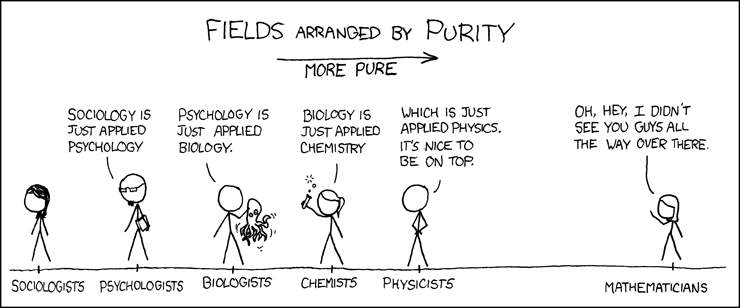
There are some inconsistent consistetcys between one truth system and another.
An integer in mathematics, for example, works similarly to the computer science representation of a 32 bit integer. But in mathematics there is no limit to how large an integer can be. The compatability of the systems only works within a specific range.
Simple question — “Is the integer 1 the same as the real number 1?”
There are limitations to consistency and compatibility even within each system.
In mathematics
- Gödel’s incompleteness theorem
- Paradoxes
- Undefined results (eg 5/0)
- The halting problem, limits of computability.
(The halting problem is an interesting historical case of overlap between these different systems of truth.
It’s more well known amongst computer scientists than mathematicians… we think of it as a computing problem… but it is a pure mathematical problem — even if many people credit the thought experiment with precipitating the invention of computers.
In science - Limitations include not just
- the Heisenberg uncertainty principle
- Can we, in a practical sense, perform the experiment needed?
- Can we gather enough data to have sufficient statistical power?
- Ethics !
- Cannot time travel to check evidence
One of the trickiest modern examples of the weird interplay of “different types of truth” is The Grand Lab Leak Theory of covid. There’s a few different versions of the theory (deliberate/accidental versus natural/man-made, etc.)
But what makes the arguments interminable is that it looks like a scientific question, but… well, it ain’t. It’s just an unknowable.
And on such topics, the less you know, the surer your opinion!
So much for truth, what about lies?
There are many types of untruth!
https://en.m.wikipedia.org/wiki/Lie#White_lie
A butler lie, “sorry, Q is not available.” A white lie Foma Therapeutic lie (dementia) Puffery Perjury Paternalistic deception Minimizing Denial Omission Weasel word I can’t. Recal Vranyo- Russian
“Hannah Arendt spoke about extraordinary cases in which an entire society is being lied to consistently”
Body language to detect lies — less reliable than you think Polygraphs — questionable
- Sun Tzu declared that "All warfare is based on deception."
Memory hole - George Orwell
Chilling effect
References
- xkcd: Purity
- Hastorf and Cantril’s 1954 paper “They Saw a Game”
- Dan Kahan in 2012 published a paper “They Saw a Protest”
- Three types of mathematical models | Theory, Evolution, and Games Group
See also
- What is the half-life of a mystery?
- Dependency Graph For Knowledge
- all models are wrong — secretGeek