
 wiki.secretGeek
What Links Here?
Outbound Links
What is the half-life of a mystery?
A 1966 story in IEEE Spectrum titled, “Technical Obsolescence” introduced the intriguing concept of “the half life of an engineering degree”. i.e., if someone attains an engineering degree in a given year, how many years will pass before 50% of the knowledge taught to that engineering student will have become obsolete or otherwise invalidated?
The concept of a “half-life” is familiar to anyone who lived during the Cold War, and the constant threat of global geothermonuclear warfare. In my childhood we learned about what we should do when we see the nuclear missiles streaming through the sky, what should we do when see the mushroom clouds erupting over the horizon. And we were taught how the radiation would last for centuries, how the geometric decay could be neatly expressed using the concept of a Half Life. Fun little facts like that helped us while away the time until our utterly inevitable annihilation.
Meanwhile, “facts” were thought to be:
- Things that are true
- Things that have always been true. And,
- Things that always will be true.
But Machlup's paper applies a more empirical approach to show that just because something is currently considered a fact, does not mean it was always considered to be a fact, nor does it mean it always will be considered a fact.
Moving on from Machlup though, I keep pondering a different scenario:

If something is currently a mystery, can we expect it to always remain a mystery?
and when considering this question, for any given mystery, it is helpful to first ask: when did this mystery first become a mystery?
To try and gather a general answer to whether a specific mystery is likely to stop being a mystery it is helpful to consider other mysteries you’ve encountered, and look at which mysteries were deemed “solved” (including those for which the premise of the mystery was entirely debunked. cough cough crop circles cough)
Gathering “all mysteries” is a difficult proposition.
When pondering the half life of a specific mystery, you may find it easiest not to ponder “all” possible mysteries, but rather the smaller set of ”the most similar” mysteries, paying particular attention to those that have been solved already, and “those that have not been solved, but are older than the current mystery under consideration”.
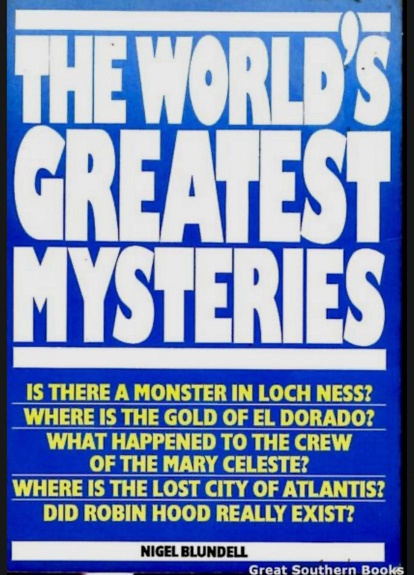
One approach is to fetch a specific "random" compendium, such as this believed "World's Greatest Mysteries" book from my childhood, and interrogate each mystery, to see which have evaporated.
Example mysteries (including those on the cover of the book):
- The Antikythera device
- Tamum shud case
- Who was jack the ripper?
- Who was the Son of Sam murderer?
- Who was "D.B. Cooper" ? -
- Crop circles
- The Wow Signal
- Little green men
- Is there a monster in Loch Ness?
- Where is the gold of El Dorado?
- What happened to the crew of the Mary Celeste?
- Where is the lost city of Atlantis?
- Did Robin Hood really exist?