
 wiki.secretGeek
Outbound Links
Fact Checking "Nightflight to Venus"
In a world bursting with too much information, it's important to distinguish fact from fiction.
How far should we go in our pursuit of truth? Should we tear down the lies of the elites? Should we destroy the old masters? Should we turn our scientific scalpel upon Boney M.'s stellar classic "Nightflight to Venus"?
Of course we should. Boney M's disco-wrapped lies have given us wildly implausible beliefs about ("Rah", shall I say, "Rah") Rasputin -- but worse, they've poisoned a generation of would-be astronomers with their lies about space travel.
The start is innocuous enough:
Ladies and Gentlemen, welcome aboard the Starship Boney M
for our first passenger flight to Venus.
This is good honest fare. It is a story concerning a trip to a distant and exotic location. This is solid story telling. At this point I expect the song to be between 5 to 8 out of 10.
Passengers, it seems, the ordinary folk like you or I, are now able to catch a flight to Venus.
We won't consider the environmental impact to Earth, nor to Venus for that matter. Let's just "go along" with it.
Here's what's next in this mad cap adventure:
Nightflight to Venus
Way out there in space
Nightflight to Venus
Our new fav'r't place
Hang about. Hang about just a dang minute.
The sheer ludicrousness of the thing ought to be apparent to all at this moment.
"Nightflight" to "Venus"
We're headed to Venus. To Venus. The Planet Venus. Got that? We're headed to Venus... AT NIGHT.
And the flight itself is at night? Not just the launch, but the flight? The “flight” part of this "nightflight" (not a real word, by the way, Boneys M) will be experienced... at night?
Allow me to draw a perfectly accurate diagram of my home, this here solar system.
In fact, just the name 'solar' is already a giveaway. "Solar" you may recall from your Latin tutelage, means "Sun".
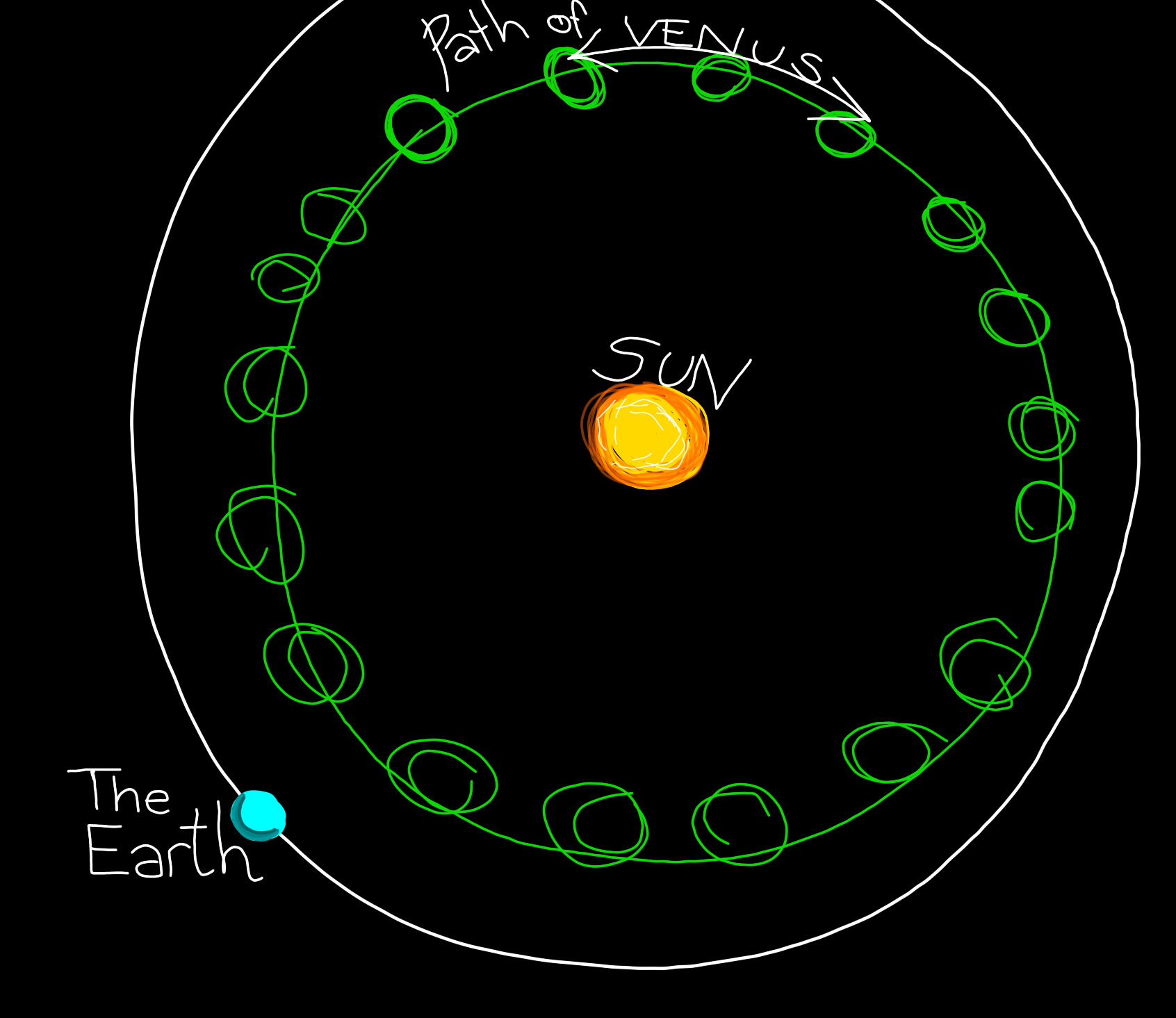
And here is the crucial bit.
If you have ever tried to organise a "night" anything you will be aware that it is crucial that one particular astronomical body is omitted from the guest list. That big bright guy there in the middle: THE SUN. “Sol” to his nerd buddies. The Sun is never ever allowed to be present for a “night” event.
Depending on when the flight departs, the relative position of Venus could be precisely -approximately between 0.3au and 1.7au (Where au means "astronomical unit", and an au of 1.0 is "the average distance from the Earth to the Sun, as the crow flies"). (The crow in this case not so much "flying" as "gliding", dead, asphyxiated, dehydrated, desiccated, ruptured, and glad not to be alive to suffer the extreme radiation sickness such a journey would elicit in the unshielded space rook.)
Here I've drawn a bunch of example flightpaths, as straight lines, from Earth to Venus, depending on where Venus is when we catch up with it. (We'll explore the actual "straightness" of such flight paths in several paragraphs' time).
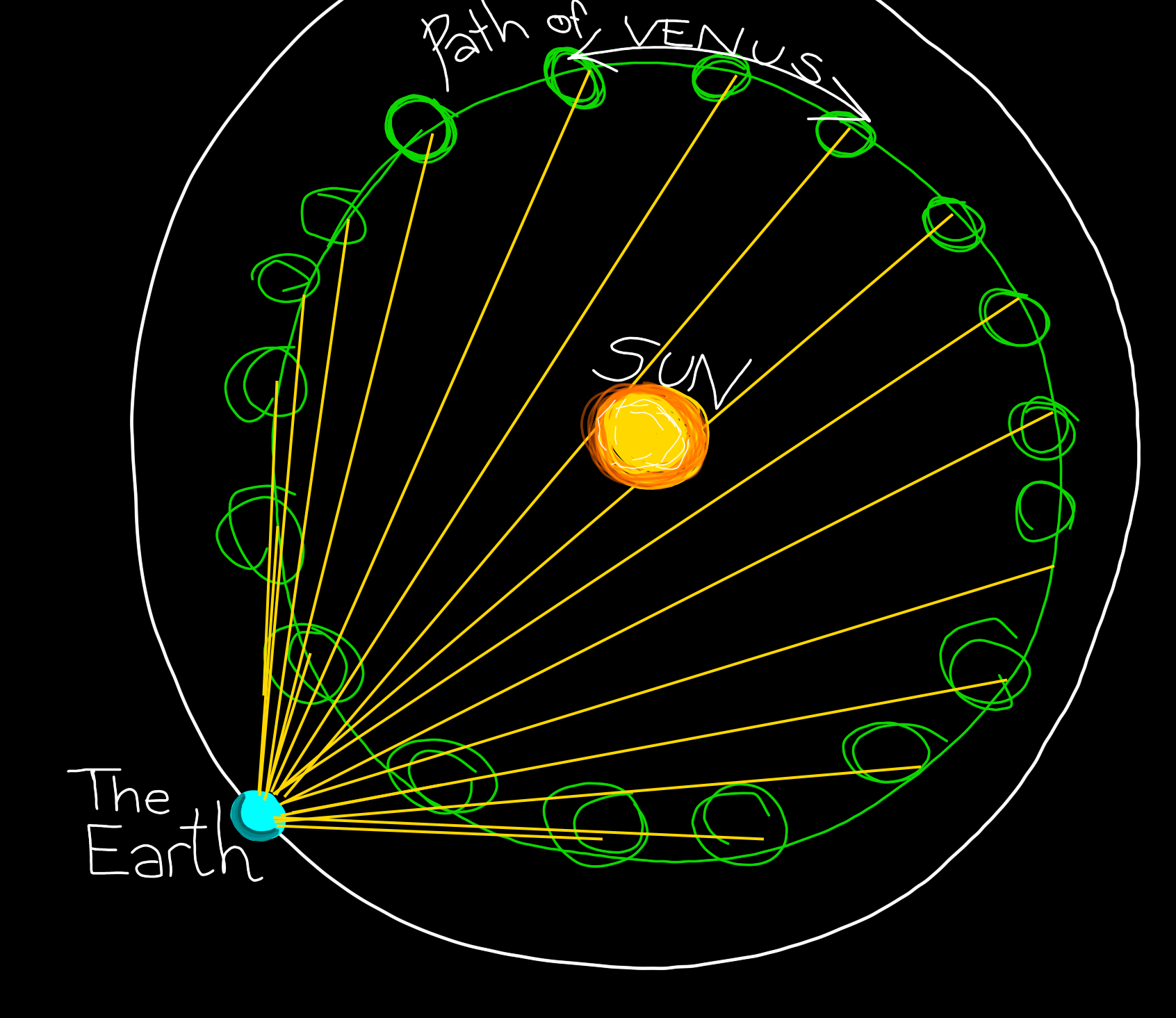
I have used my "Bright Cyan" paint pen for all parts of the flight that are not visible to the Sun, and I've used Bright Yellow for all parts of the flight that are drenched in sunlight.
The astute observer will confirm that this exercise did not require the use of any bright cyan, because all parts of the flight, regardless of when it occurs, are fully visible to the Sun.
But what if we travelled in the shadow of Venus?
A pesky reader has sent me a nasty missive asking about a very specific possibility which they think the song may have been referring to, but which I have allegedly overlooked.
"What if the spaceship chose a route that was travelling in the shadow of Venus? Didn't think of that did you, you big pumpkin."
I am not a pumpkin, but yes I did give that scenario some thought -- quite a bit of thought as you shall see -- and it does not at all represent a situation that any sane marketing department, advertising their flights to Venus, would choose to promote as a "Night Flight to Venus". Let us dig into this "Shadow" theory.
Imagine if you will that rocket scientists have chosen a very specific path from the earth to Venus which is entirely in the narrow band of "shadow" cast by Venus:
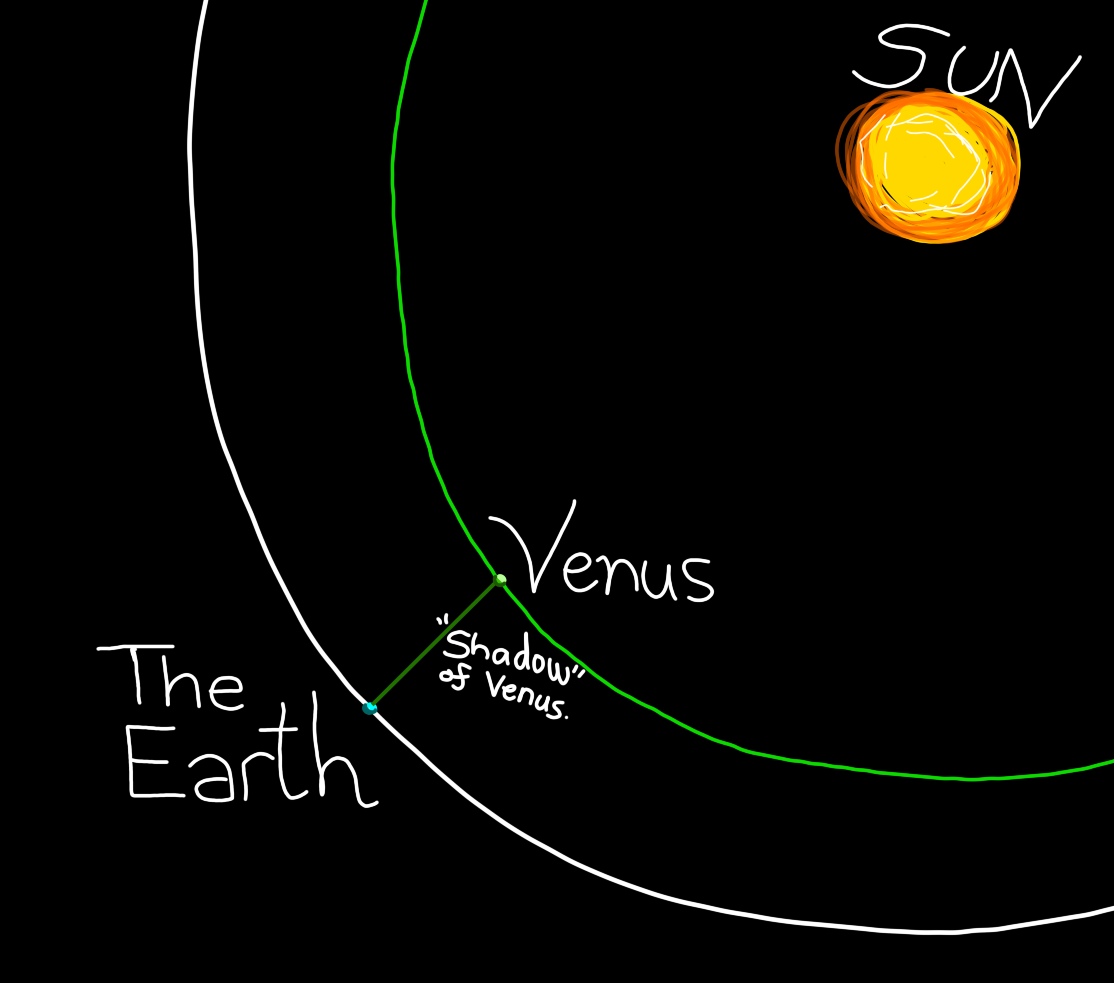
I’ve drawn Venus and the Earth a lot smaller for this example. They are still represented as far larger than their true scale, but my eyes are not what they were; every little helps. I’ve drawn a straight line representing the “shadow of Venus”. You may observe that I’ve drawn it in dark green, but please don’t think that Venus casts a green shadow. For Venus to cast a green shadow it would need to be translucent, or semi-transparent, and tinged green. Neither of these things are true. (Venus is of course purplish orange but there I have digressed).
When the shadow of Venus happens to fall upon the earth we do not say, "Ah, it is night-time!" At a human scale, we do not experience any darkening of the daylight, at all.
What we say is "look at that tiny dot in front of the sun! Ouch my eyes" -- and we refer to it as "The transit of Venus across the sun" and if we are of the astronomical persuasion we get very very excited and try to convince our friends to look at the sun too, without looking at the sun, which is a hard sell. If we are prog rock fans we may call it an eclipse. Venus has eclipsed the sun. We would not call it a "total" eclipse, as the relative distances mean that even the Venus is "fully" in front of the sun, only a small percent of the sunlight is occluded. In fact the correct astronomical term for it is "occult" -- Venus is "occulting" approximately 0.1% of the visible disc of the sun.
Still, I am sure my learned correspondent would argue that a marketing department may choose to call this a "Night flight" -- and to this I call baloney. "Baloney".
The transit of Venus, the partial solar eclipse of Venus, is far far too rare and important for any self-respecting marketing department to downplay the event by referring to it as "night time". A marketing department might make an event sound more important than it is -- never would they intentionally make an event seem less important.
When Venus transited the sun in 2004, there was not one person alive on the planet who had witnessed the event for themselves, the last time it occurred, in 1882.
Here on Earth, we see a pair of transits occur eight years apart, then a gap of 120 years, another pair of transits eight years apart, then a gap of 105 years, and so on.
There was a pair of transits in 1874 and 1882, then a pair in 2004 and 2012. And the next pair of transits will be in 2117 and 2125.
Ladies and gentlemen we have had a successful take-off
On this first night flight to Venus
Our flying time will be eight hours
You'll be travelling at a speed of 2,183 miles per second
That is seven and one half million miles per hour
The distance from mother earth to Venus is 60 million miles at this timeTo your left you can see the mountains of the moon and right
In the centre, under a huge plastic bubble, Moon City
A boomtown if ever there was one, because of the huge gold and diamond veins
As for Venus, it took almost ninety years to cool down the planet from its 500 degrees to the current pleasant 75 degrees and to transform the atmosphere to make it habitable for Earth's people
Later lyrics in the song indicate (as we shall see) this 1978 song: if it was referring to a transit of Venus, it could not have been referring to either the 2004 or the 2012 transit of Venus. At the earliest it would need to be referring to the 2117 transit of Venus.
If the proprietor's shipping line under which sails the vessel carries the banners midst snow and ice, of the "Starship Boney M" have patiently waited over 100 years for a transit of Venus, they will not refer to it as just a jolly old bit of "nightflight".
The site itself on such a hypothetical journey would be very interesting. Venus, as we've discussed, would start out as a tiny dot, occulting almost none of the sun -- but throughout the journey, Venus would appear to grow and grow, relative to the sun, until it completely occults the sun!
Our flying time will be 8 hours.
We'll be travelling at a speed of 2,183 miles per second.
Will we now? Let's see how this stacks up.